

TL;DR – Summarise this page with AI
A modern dental practice doesn’t run on a chair and a drill anymore – it runs on a stack of software that books the appointment, answers the phone, images the tooth, files the claim, collects the payment, and asks the patient for a review afterward. Most practices assemble this stack one system at a time, usually after something breaks: a missed call that cost a new patient, a financing conversation that stalled at the front desk, a recall list nobody ever worked. This guide breaks down the seven software categories a dental practice actually needs, names the tool leading each category by verified US search traffic, and backs every pricing claim and pro/con with what’s published on the vendor’s own site or reported in real G2 and Trustpilot reviews.
What Actually Belongs in a Dental Practice’s Software Stack
Strip away the jargon and a dental practice’s software stack covers seven jobs: answering and documenting every phone call, managing the clinical and business side of the practice, keeping patients scheduled and informed, generating and managing online reviews, capturing diagnostic images, financing treatment patients can’t pay for outright, and keeping the books. Skip any one of these and it shows up as a real cost – a missed call that becomes a lost patient, a treatment plan that gets declined because there was no financing conversation, or a set of books so far behind that tax time becomes a crisis.
This list covers one tool per category rather than seven variations on the same thing. Every non-phone company below was checked against G2 and Trustpilot review data and confirmed as the traffic leader in its category using Semrush – not just picked because it’s well-marketed.
The 7 Software Tools Every Dental Practice Needs

1. Nuacom – Business Phone System & AI Call Handling
The phone is still where most new patients make first contact with a practice, and it’s the one system on this list that touches every other one – the call that books through your practice’s phone line is the same call your practice management software, your recall list, and eventually your accounting all depend on. Nuacom is a cloud business phone system built around that reality: every call can be recorded, transcribed, and summarized automatically through Nuacom’s AI call features, including Call Transcription, Call Summary, Action Items, Key Point Recognition, Keyword Trackers, and Emotion & Sentiment Analysis – useful for a front desk trying to catch every request in a rushed call without relying purely on memory or handwritten notes.
Beyond the AI layer, Nuacom covers the fundamentals a dental office needs from a phone system: IVR and Auto Attendant to route calls without a receptionist picking up every line, Call Analytics and a live wallboard for tracking answer rates, two-way Business SMS for appointment confirmations and reminders, Voicemail to Email, and a Missed Call Follow-Up Report so a call that wasn’t picked up doesn’t just disappear. It also integrates directly with the CRMs and helpdesks a lot of practices already run alongside their PM software, including HubSpot, Salesforce, Zoho, Pipedrive, and Microsoft Teams.
On Nuacom’s pricing page, the Unlimited plan runs €25/user/month billed monthly or €19/user/month billed annually, and the Enterprise plan – which adds live call coaching, an auto dialer, and video calling – runs €35/user/month monthly or €25/user/month annually. Contracts run on a 30-day rolling basis, with an annual option for the discounted rate, and add-ons like extended call recording retention (€5/user/month) and the Nuacom AI features (€9/user/month) are priced separately from the base plan.

2. Denticon – Practice Management Software
Denticon, built by Planet DDS, is a cloud-based practice management platform aimed primarily at dental support organizations (DSOs) and multi-location groups, though it also serves single practices. It covers scheduling, patient check-in through SmartAssist, AI-assisted perio and restorative charting, revenue cycle management with automated claims submission, and Planet DDS Pay for patient payment processing, all backed by SOC 2 Type 2 and HIPAA-aligned security. Planet DDS reports more than 13,000 dental practices on the platform.
Denticon doesn’t publish pricing publicly. Its site lists three tiers – Essentials (1-2 locations), Pro (3-19 locations), and Enterprise (20+ locations) – but every one requires a sales call to get an actual number, plus a “Launchpad” discounted first-year offer for emerging groups with no published rate.
Pros (per G2, 4.7/5 from 74 reviews): Reviewers highlight a smooth implementation and onboarding process, meaningful reductions in IT overhead after switching from server-based systems, straightforward integrations with other dental vendors, and an interface front-desk staff and assistants pick up quickly.
Cons: Users report gaps in built-in reporting – specifically for cleaning up unused treatment plans or flagging patients overdue for a visit – along with some UI friction in plan setup, and a handful of reviews describe support as inconsistent in tone when problems are escalated. Denticon does not have a meaningfully populated Trustpilot profile, so this assessment leans on G2 and Capterra.
3. NexHealth – Online Scheduling & Patient Communication
NexHealth is a patient experience layer that sits on top of a practice’s existing PM system – it connects to more than 80 EHR and practice management platforms to sync real-time online booking, digital intake forms, automated recall and reminder messaging, review requests, payments, and insurance eligibility checks. NexHealth reports more than 10,000 medical and dental practices on the platform and claims to automate roughly 75% of front-office administrative tasks.
NexHealth doesn’t list pricing on its site either; it advertises “flexible monthly plans” with no long-term contract but requires a sales conversation to get a number.
Pros (per G2, 4.8/5 from 84 reviews): Reviewers score NexHealth especially highly on ease of use (9.5/10) and patient communications (9.9/10), consistently calling out fast, responsive support and an online booking flow that integrates cleanly with legacy systems like Dentrix.
Cons: G2 reviewers cite occasional technical issues and feature gaps compared to more full-featured platforms. Trustpilot reviews for NexHealth are mixed – some describe billing continuing after they believed they’d cancelled, or a feature (like referral tracking) stopping working after a couple of months, while others specifically praise the Dentrix integration and an intuitive interface for staff.

4. Birdeye – Reputation Management & Patient Reviews
Birdeye centralizes review generation and monitoring, messaging, webchat, social posting, and referral requests into one dashboard – useful for a practice trying to build a steady stream of Google reviews without a staff member manually chasing every patient down. It’s priced per location rather than per seat, and pricing is entirely quote-based: Birdeye’s own pricing page doesn’t list a single dollar figure, just a locations selector (1-3, 4-9, 10-39, and so on) that feeds into a “get pricing” form.
Multiple independent pricing trackers report starting rates in the $299-$449/month range per location on published rate cards, with optional add-ons (surveys, referrals, mass texting) around $100/month each and standard annual contracts – but since Birdeye doesn’t publish this itself, treat any figure quoted to your practice as the number that matters, and confirm contract length and cancellation terms in writing before signing.
Pros (per G2, 4.7/5 from roughly 4,190 reviews): Reviewers consistently praise ease of use, the time saved by automating review requests across multiple channels, and responsive customer support.
Cons (per Trustpilot, 3.4/5 from 243 reviews): Trustpilot’s rating is notably lower than G2’s – recurring complaints involve difficulty cancelling, charges continuing after a cancellation request, and unexpected costs beyond what was originally quoted. Given the gap between the two platforms, it’s worth reading recent Trustpilot reviews directly before signing an annual contract.

5. Dexis – Digital Imaging Software & Sensors
Dexis, part of Envista, covers the imaging side of the stack: its DTX Studio Clinic platform consolidates 2D and 3D imaging, intraoral scanning (including the Imprevo scanner), and AI-assisted diagnosis and treatment planning tools into one workspace, alongside hardware like the NOMAD Pro 2 handheld X-ray unit and the Orthopantomograph OP 3D series for panoramic and 3D imaging. Dexis reports more than 165,000 of its imaging solutions in use worldwide after roughly 70 years in business.
Pricing isn’t published on the Dexis site; sensors and imaging systems are quoted directly, though the site does mention a 60-day satisfaction guarantee on eligible purchases.
Pros (per G2’s DEXIS Imaging Suite listing, 4.6/5 from 21 reviews): Reviewers highlight image quality, a workflow that integrates well with existing practice management software, faster image capture and retrieval, and solid training and support resources.
Cons: Recurring complaints center on sensor durability – sensors are reported as fragile, work only with Dexis’s own software, and some reviewers note failures around the USB connection over time – plus software that can slow down when loading a large volume of images. Dexis doesn’t have a meaningful Trustpilot presence as an imaging hardware vendor, so this verdict is based on G2 and Capterra review data rather than Trustpilot.
6. CareCredit – Patient Financing
CareCredit, a Synchrony product, is the financing option patients are most likely to already recognize, with a network the company reports at more than 200,000 provider and retail locations. It lets patients split the cost of treatment into payments – either deferred-interest promotional plans or fixed monthly-payment plans – while the practice is paid upfront by Synchrony rather than waiting on the patient directly.
CareCredit doesn’t publish a merchant fee schedule for practices on its consumer-facing site; that’s set up directly with a Synchrony provider enrollment representative. For patients, terms vary by plan and promotion.
Reviews (Trustpilot, several hundred reviews): The most common complaints are about deferred-interest terms – patients report being caught by a standard APR reported as high as the mid-30s once a promotional window closes or a payment is missed, along with fees such as a reported $1.99/month charge for paper statements, and a requirement that payments come from a checking account rather than a credit card. On the positive side, reviewers who paid off their balance inside the promotional window do report genuine 0% interest savings, and many cite the sheer size of the provider network as a real convenience. CareCredit isn’t widely reviewed on G2, since it’s a consumer financing product rather than practice-facing software – Trustpilot is the more relevant source here, and it’s worth walking new patients through the exact terms before they sign up rather than assuming the promotional rate is guaranteed.
7. QuickBooks – Accounting & Bookkeeping
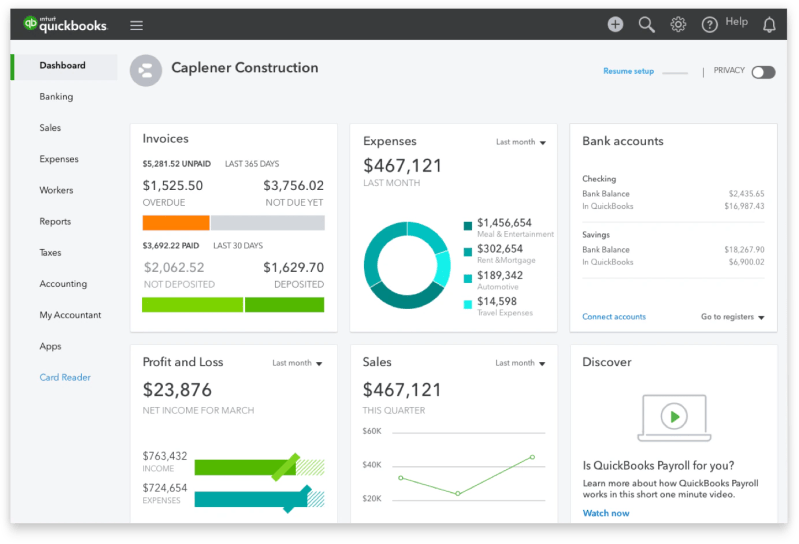
QuickBooks Online, from Intuit, is the accounting software most dental practices end up on by default, covering everything from basic income and expense tracking up to bill pay, time tracking, and multi-currency support depending on plan. Intuit’s published plans are Solopreneur ($0/month), Simple Start ($38/month), Essentials ($85/month), Plus ($140/month), and Advanced ($340/month), with payroll, Live Bookkeeping, and QuickBooks Time all priced as separate add-ons. Intuit raised prices across the Essentials, Plus, and Advanced tiers on 1 August 2026, so confirm current rates directly at quickbooks.intuit.com/pricing before committing to a plan.
Pros (per G2, around 4/5): Reviewers consistently cite ease of use for non-accountants, cloud access from any device, and integrations with tools like Bill.com and Ramp.
Cons: The most common complaint is cost creep as a practice adds users or features, along with occasional lag on larger data sets and inconsistent support response times. Trustpilot tells an unusually split story by region: QuickBooks’ US Trustpilot profile sits at just 1.1/5 from 1,244 reviews – a profile Intuit doesn’t actively solicit reviews on, so it skews toward complaints – while the UK Trustpilot profile, which Intuit does manage and solicit reviews for, sits at 3.9/5 from roughly 16,600 reviews. A UK or Irish practice reading only the US score would get a distorted picture of the day-to-day experience most users report.
Quick Comparison: Pricing at a Glance
| Tool | Category | Starting Price | Pricing Model |
|---|---|---|---|
| Nuacom | Business Phone & AI Calls | €19-€25/user/month (annual) | Published, per user |
| Denticon | Practice Management | Quote only | Per location tier, contact sales |
| NexHealth | Scheduling & Patient Comms | Quote only | Monthly, no long-term contract, contact sales |
| Birdeye | Reputation & Reviews | Quote only | Per location, contact sales |
| Dexis | Digital Imaging | Quote only | Hardware + software, contact sales |
| CareCredit | Patient Financing | No cost to enroll (merchant fees apply) | Per-transaction, contact Synchrony |
| QuickBooks | Accounting | $0/month | Published, tiered plans |
Nuacom and QuickBooks are the only two tools on this list with transparent published pricing you can see before talking to a salesperson – worth factoring in if your practice would rather budget from a rate card than sit through a locations-based quote call.
Choosing the Right Stack for Your Practice
A single-location practice doesn’t need Denticon’s DSO-scale enterprise tier or Birdeye’s multi-location pricing model – start with the category that’s actually costing you patients today, not the category with the loudest marketing. For most practices that’s the phone: a missed call from a new patient rarely turns into a voicemail, it turns into a call to the next practice on the list. Getting IVR and call routing right, so that calls are answered fast and accurately, tends to pay for itself before you’ve finished evaluating the other six categories.
From there, sequence the rest based on where the visible gap is: a practice with a full schedule but a stagnant review count should prioritize reputation management before it prioritizes new imaging hardware; a practice declining a lot of treatment plans over cost should have a financing conversation built into case presentation before it upgrades its accounting software. Layering in one system at a time, with a few weeks to measure the effect before adding the next, beats replacing the entire stack in a single quarter.
What to Track After You Adopt These Tools
- Inbound call answer rate – the share of calls picked up promptly, trackable through Call Analytics.
- New patient conversion rate – how many new-patient calls or online bookings actually turn into a scheduled first visit.
- Case acceptance rate – whether financing conversations are measurably improving treatment plan acceptance, not just getting offered.
- Review volume and rating trend – month-over-month, not a one-time snapshot.
- Days in accounts receivable – a rising number here often means a financing or billing gap upstream.
None of these numbers mean much in isolation – track them together for a full quarter before deciding whether a tool is underperforming or the rollout just needs more time.


Final Word
The seven categories above cover the software a dental practice genuinely depends on – not a wish list. Most practices already have two or three of these in some form; the gap is usually the phone system, since it’s the one piece of the stack that’s easy to treat as “just a phone line” rather than the AI-documented, analytics-backed front door it can actually be. Get that part right first with Nuacom, and the rest of the stack has something solid to plug into.
Frequently Asked Questions
At minimum: a business phone system for call handling, practice management software for scheduling and clinical/billing workflows, a patient communication tool for reminders and recall, a reputation management tool for reviews, imaging software, a patient financing option, and accounting software. Most practices already run some combination of these – the goal is making sure each category is actually covered rather than assumed.
A modern business phone system like Nuacom runs on cloud infrastructure and includes call routing, AI transcription and summaries, analytics, SMS, and CRM integrations – closer to a full communications platform than a traditional phone line. Because it’s the first touchpoint for most new patients, it directly affects conversion rates in a way a basic landline never could.
Denticon offers an Essentials tier built for practices with one or two locations, so it does serve single offices, but its feature set and marketing are weighted toward multi-location DSOs and dental groups. A solo practice should compare the Essentials tier directly against other single-location practice management tools before committing.
Yes, in the sense that the practice is typically paid upfront by the financing provider rather than waiting on the patient to pay over time – the practice’s collections risk is transferred to Synchrony. Whether it helps the patient depends heavily on the specific terms, since deferred-interest plans can result in a high retroactive APR if the balance isn’t cleared in the promotional window.
Some of it overlaps directly – Nuacom and QuickBooks both operate and price in the UK and Irish markets – but others, like CareCredit, are US-only financing products, and UK/Irish practices typically use different patient financing and practice management options local to their market. Always confirm regional availability before assuming a US-focused tool applies.
Each non-phone category was shortlisted from current search results for that category, then checked against Semrush organic traffic data for the US market to confirm which vendor actually leads on search visibility rather than relying on marketing claims alone. Pricing and features are sourced from each vendor’s official site, and pros and cons are drawn from G2 and Trustpilot review data where each vendor has meaningful review volume.


